

☢️Fallout: Newer Vegas
Lore, Creatures, and the Season Two Finale



Spoiler Warning: This Season Two review of Prime Video’s Fallout discusses details from the last three episodes of the season, as well as the endings of the games Fallout: New Vegas and Fallout 4.
It Begins With Macauley
The season two finale of Fallout, “The Strip,” opens to Macauley Caulkin’s character, Lacerate Legate of Caesar’s Legion finding a note on the body of the former Caesar, all while the Legion’s civil war crisis rages on in the background. Legate opens the note with trembling hands, upon which is written “I am the Caesar. I am the Legion. It ends with me.”
He quickly kills the only witness to the note and eats it, taking his opportunity to become the new Caesar himself. The Legion, who pronounce “Caesar” like the German “Kaiser,” but with an “-ar” ending, begin making their way to New Vegas for an epic battle—which we have to wait until Season Three to witness.
The finale builds up towards what will ultimately be an epic battle of the factions in Season Three, with the Legion and the NCR on the Vegas strip. Plus, the Brotherhood plans to employ a Liberty Prime Alpha, and the Enclave is ever-present—but I digress. Let’s back up and break down this universe for the uninitiated:
Fallout Timeline
Pre-War Era (2050s–2077): Retro-futuristic
The Great War (Oct 23, 2077): Nuclear annihilation destroys the world
Early Post-War (2077–early 2100s): Survival, radiation, mutations
Mid Post-War (2100s–2200s): Settlements form, factions rise
Fallout: New Vegas (2281)
Late Post-War / Present Day (2290s): reckoning begins.
We’re in 2296 in season 1; 2297 in Season 2.
The Ghoul / Cooper Howard
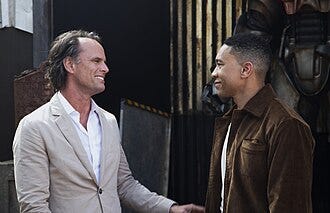
Walton Goggins plays dual roles in Fallout: the Pre-War Cooper Howard, and the present-day 2297 Ghoul. Goggins derives his inspiration for playing the Cooper Howard’s character from Western film stars of the 1950’s and 60’s. While the Fallout Pre-War era lasted until 2077, it featured a retro-futuristic aesthetic, heavily inspired by the culture and style of the 1950’s and 60’s. Goggins told The Hollywood Reporter:
“Cooper is real to me. I believe that I could find him in Los Angeles if I were here 50, 60 years ago. Who were his contemporaries, the people that he was up against, who he lost jobs to? Where was he on the pecking order? He wasn’t John Wayne, but there might be a version of his experience where he was Alan Ladd, certainly James Arness. I watched a lot of existing interviews that I could find of eight different actors, including Jimmy Stewart and Henry Fonda.”
Lucy, Hank, and….*checks notes*…Steph?

Ella Purnell’s character Lucy faced an identity arc this season—reconciling her desire for peace with the brutality of the surface. She rejects her father’s use of mind-control, but recognizes the difficulty in defeating the Legion, now that she knows they are coming.
The reveal about Steph, played by Annabel O’Hagan, adds a new layer to Lucy’s identity arc. Lucy’s Season One interactions with Steph show a neighborly, seemingly benign relationship, but the Season Two reveal clarifies that Steph was legally still Hank’s wife from pre-war cryo, secretly working with him on Enclave operations.
It seems like Hank was likely thawed from cryo earlier than Steph, leading him to marry Lucy’s mother and have two kids with her, before Steph was thawed—upon which she married the father of her baby, who was killed by raiders, creating a tangled web of personal and Vault-Tec-driven relationships.
The Fallout universe is all about twisted family relationships involving cryo-chambers, and Enclave secrets. In Fallout 4, the main player is searching for his son, Shaun, who he later discovers is called “Father,” the leader of the Commonwealth Institute of Technology. Shaun is much older when found, even older than his real father, since Shaun was taken from cryo as a child, and allowed to age up, while the player was still stuck in cryo.
The Return of the NCR
The Season One reveal about the bombing of Shady Sands left many questions in the air regarding the status of the New California Republic. However, just as Maximus has given the last of his energy to his Deathclaw battle, a lone shot rings out. The camera pulls back to reveal an NCR sniper as he fires a round, which the viewer follows in bullet-time, as the projectile exits the rifle and strikes the Deathclaws.
Vault-Tec Secrets and Technolog
Vault-Tec is a pre-war industry who purport to offer safe shelters buried deep in the earth to protect consumers from radioactive fallout. However, the safety promised is only a facade. The true fallout is the diabolical experimentation housed in each vault.
This season, we learned through Barb Howard that Vault-Tec planned vault failures, showing that Vault-Tec knowingly designed some vaults to collapse as part of a larger experiment. Barb listens to an explanation of the water chip failures at work in Episode Six. This shows Vault-Tec knows which vaults are going to fail and can include that as a variable in their experiments.
Hank’s experimentation objective this season was perfecting the mind-control technology originally designed by Robert House. He uses individuals who are unpredictable, violent, and traumatized, and erases any negative memories (which could be all someone’s memories) and links their executive function to Congresswoman Welch. Welch begs Lucy for death, as she has become a tool of the very system she opposed in life.
Lucy realizes she cannot return to the vaults after all she discovered. However, Hank reminds her before he wipes his own memory:
“you think this is the real world — the surface is the experiment, not the Vaults.”
Supernatural and Biological Threats
The appearance of Deathclaws this season intensified the stakes for our protagonist. The show’s designers brought the creatures to life more vividly than in the games themselves, drawing on detailed concept art—most notably the Radscorpians, whose size makes them a truly menacing foe. Meanwhile, Thaddeus, played by Johnny Pemberton, undergoes a shocking transformation into a mutant, and not a ghoul like he thinks. Unfortunately, the type of mutant seems to resemble a centaur, but we’ll see.
The Ghoul Just Undid All Your Hard Work
Gabran Gray said it best in his article for Looper: “Lore never changes.” But when that lore diverges into alternate game-endings, adapting it into the show’s canon gets tricky. For anyone who’s ever played Fallout: New Vegas, the last couple of episodes of Season Two both canonize and undo one of the game’s endings:
Fallout: New Vegas Endings (Set about 15 years before the show’s present)
The NCR win the Second Battle Hoover Dam and fold in the Mojave.
The Legion Wins and conquers the Hoover Dam and Mojave.
Mr. House Wins and he uses the Hoover Dam to power his vision and to hold power over others
Independent Vegas (Yes Man Ending): Th Yes Man computer AI helps you decommission Mr. House. In this ending, the NCR and Legion are both expelled and the player becomes de facto power behind New Vegas.
It does seem like the Yes Man Ending was canonized with Mr. House’s line, “Over the years my body became something of a target for wandering travelers trying to make a name for themselves.”
If this is the version they’re canonizing, it would mean that The Ghoul just undid all the player’s work in Fallout: New Vegas, which would also be kind of funny at the same time. It’s very on-brand for Fallout, blending dark humor and shocking reveals—reminding viewers that no matter what happened in the games, the show can still create possibilities within the game’s lore.
More Bygone and Buzz to come: Buy Me a Coffee to support my work!
This post was brought to you by Bygone & Buzz and Daniel Baker.
 | A guest post by
|
I enjoyed the season but overall thought it was a tiny bit weaker than the first. As a massive fan of the game, it was really cool seeing some New Vegas locations, but I wish there were more iconic stop off points throughout the season. I'm personally not fussed about them altering with the game endings here because in my head the choices I chose still happened, then the rest happened afterwards and was out of my courier's control. The wasteland is unpredictable after all. I can definitely see why people might be conflicted about this though.